Pine essential oil
Element - Metal
Property - refreshing
Note - Head
Group - Essential oil
Synonym - Scots pine
Botanical name - Pinus sylvestris
Plant family - Pinaceae (pine family)
Contents
Botany
Botanical name
Pinus sylvestris
Plant family
Pinaceae (pine family)
The pine family (bot. Pinaceae) belongs to the order Coniferales (conifers). As vascular plants, the pines belong to the seed plants (Spermatophytina) within the Coniferopsida class. Pine plants usually present themselves as stately trees and are represented in some genera as shrubs. Pine plants have needle leaves. The needles of most Pinaceae species remain on the tree or shrub for several years and are evergreen.
Source: → Detailed information about the Pinaceae plant family - Hostmann Nursery
Origin & distribution
The pine family is mainly found in the northern hemisphere. In the northern hemisphere, pines are found in Europe, Eurasia, North America and Asia. Towards the south, the distribution area extends to North Africa, the Caribbean islands, Central America, the Himalayas, China, Japan and Indonesia.
The trees form large, extensive coniferous forests. The various species of Pinaceae can be found in both cold polar and warmer Mediterranean regions. In higher mountainous regions, the pines are usually the dominant tree species.
Origin for the production of the oils
USA, Russia, Baltic States, Scandinavia
Part of the plant used
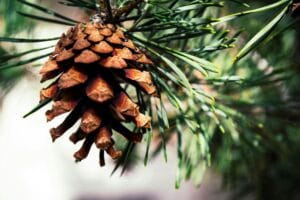
For the production of pine essential oil, mainly the needle tips and the bark are used.
Ingredients Pine essential oil
- Monoterpenes: 60 - 70%
- Sesquiterpenes: 0.5 - 5.4%
- Monoterpenols: 1 - 2%
- Sesquiterpenols: α-cadinol
- Ester: up to 10% bornyl acetate
Warnings
Internal use:
- Not for pregnant women, infants and small children
External application:
- Only in low concentrations for infants
Background
There are more than 100 species of pine and fir from which essential oils can be produced.
For medicinal purposes, the oil is extracted from the needle tips or the bark by steam distillation.
Even in ancient times, the pine cone was regarded as a symbol of fertility and wealth due to its abundance of seeds. A single pine cone can contain around 40 to 50 seeds. Counting the number of scales times two gives the total number of seeds in a pine cone.
The pine tree is also a symbol of longevity, endurance and resurrection, because in Eastern Europe it is still said today that the nails with which Jesus was nailed to the cross were carved from pine wood.
Aroma
Grade
The perfumery counts pine oils among the Top notes.
Top notes
The top note describes aromas that are perceived immediately after opening the container. The top note conveys the first and often the decisive impression of a fragrance composition. They are often fresh citric, green, aquatic and Airy fragrances. The volatile fragrance molecules that open the door to the next fragrance phases evaporate very quickly. Already 10 - 15 minutes After application, there is hardly anything left of the top note fragrance.
Fragrance
balsamic, resinous, coniferous, spicy
Mixes well with...






Find the right etheric oil combination quickly.
Carrier oils
Possible carrier oils depend on several criteria such as skin type and effect. Below I list some neutral carrier oils that can be used well because they are odorless and generally well tolerated.


- All essential oils and carrier oils can be practically sorted -
Body, mind & soul
In the Body, Mind & Soul section, a possible therapeutic use of essential oils is described. An attempt is made to make both the Western and the Eastern perspective transparent.
The Western approach can be found under Effect and use differentiated according to body and mind & soul. For comparison, the Eastern approach describes the chakras and functional areas.
As an Aromatrix+ reader, simply read on now...
AROMATRIX - PLUS
in the practical flavor manual AROMATRIX
with comprehensive fact sheets on all oils
--- Aromatrix + oils profiles ---
Western approach
This section is written for the aroma therapy expert:
Effect
BODY
stimulating, antibacterial, antimicrobial, anti-infectious, antifungal, antineuralgic, antirheumatic, antiseptic (atmospheric), antiviral, expectorant, balsamic, increases blood pressure, lowers blood sugar, cortisone-like, deodorizing, circulation-enhancing, bile-stimulating, diuretic, immune-strengthening, insecticidal, lymphatic system decongestant, nerve-strengthening, expectorant, diaphoretic, testosterone-like
Mind & Soul
stimulating, promoting convalescence, clarifying
Use
BODY
Abrasions, arthritis, asthma, low blood pressure, bronchitis, diabetes, poor circulation, eczema, colds, physical exhaustion, fever, boils, gallbladder inflammation, joint inflammation (rheumatic), ulcers, gout, flu, sore throat, urinary bladder inflammation, cough, catarrh, whooping cough, scabies, lice, impotence, sciatica, sinusitis, neuritis, oedema, sore muscles, muscle pain, fungal infections, inflammatory and allergic processes, pharyngitis, rheumatism, cuts, colds, excessive sweating, tendon pain, wounds
Mind & Soul
Mental exhaustion, hopelessness, lack of concentration, tiredness, weakness, stress-related complaints
Eastern approach
This section is written for the TCM expert:
Pine needle oil warms the lungs and helps to let go of negative attitudes to create a new perspective on life.
5 elements
Metal element
The essential oil of pine needles is assigned to the element metal.
The element assignment of an essential oil is determined by the →Aroma profile and the direction of action. Pine needle oil has both yin and yang components. It is used as Yin in Yang because inward movements are already present in the fragrance.
Chakras
Sacral Chakra (2nd Chakra)
The essential oil of pine needles is associated with the sacral chakra (2nd chakra).
As an essential oil can have several properties, it can also be assigned to several chakras. Pine essential oil also addresses the brow chakra (6th chakra).
A detailed explanation can be found in the following article: → Etheric oils & chakras
Functional areas
Qi deficiency
expels the cold from the lungs, Tones and strengthens the lung qi, fills the chest: Respiratory tract infections, bronchial congestion, cough, asthma, colds and flu with chills and fatigue and white phlegm, dry cough, chest pain, wheezing, acute and chronic bronchitis, pneumonia, pulmonary tuberculosis, sinus pain and congestion, sinusitis, debilitating fatigue, shallow breathing
frees the mind, strengthens the psyche / instinctLack of self-confidence, weak boundaries - where you can't distinguish your responsibility from someone else's, negative self-image, remorse
tonifies the kidney, tonifies the spleen and kidney yang: Lower back pain, rheumatic pain and arthritis, cystitis, pyelonephritis, prostatitis, physical, mental and sexual fatigue, adrenal insufficiency, excessive sweating of the feet
strengthens the stomach and spleen: swollen and painful abdomen, acid regurgitation, nausea, vomiting
Main use:
pale, tired, exhausted, weak voice
Psycho-emotional representation:
hypersensitive, overanxious, antisocial, exaggerated need to correct injustice
Sources:
Icon by Olga from Noun Project (CC BY 3.0)
Texts are based on the following publications in addition to already marked sources:
Pocket dictionary of aromatherapy by Dietrich Wabner, Verlag Systemisch Medizin, 2013
Aromatherapy with Chinese Medicine by Dennis Willmont, Willmountain Press, 2003
Applications